Both and Neither: The Creative Superpower Nobody Talks About
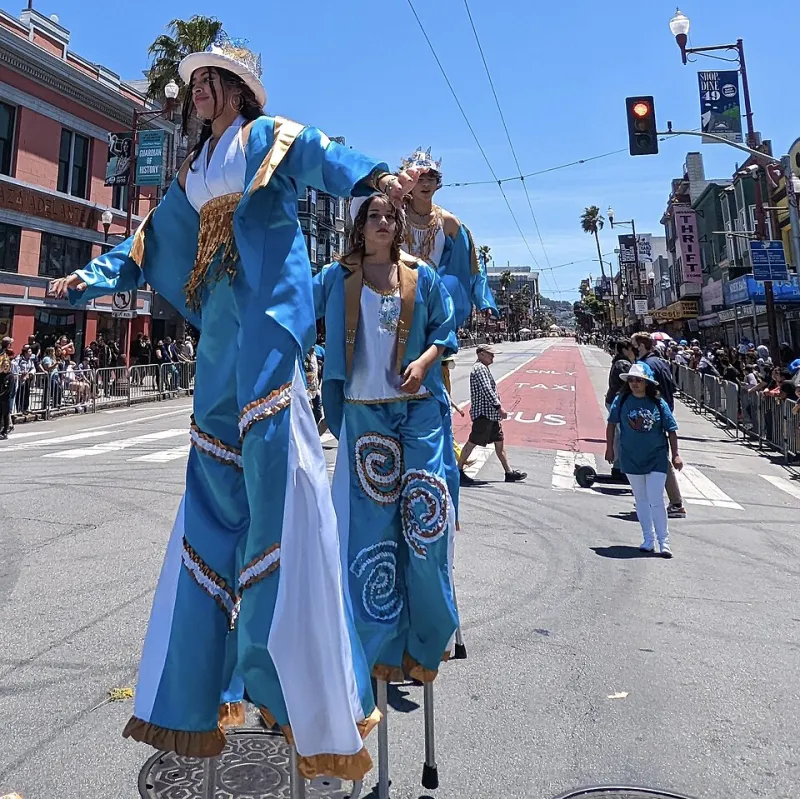
Photo: Carnaval.com Studios from The Inner Mission San Francisco, Earth, CC BY 2.0, via Wikimedia Commons
I want to tell you about a specific kind of cognitive workout that millions of people do every single day without thinking of it as a skill.
You're at your parents' house for a holiday dinner. In the span of two hours, you navigate two different languages, three generational worldviews, at least one argument about what counts as success, and the particular emotional calculus of being someone who exists fully in two worlds — and is sometimes made to feel like a stranger in both. Then you go home, open your laptop, and make something.
For artists who grew up in diaspora households, immigrant families, or multicultural environments, that navigation isn't a side effect of their life. It's the engine of their creative work. And it produces something that a single-culture perspective simply cannot manufacture on its own.
The Translation Tax — and What It Buys
Let's be honest about the cost first, because glossing over it would be dishonest. Living across cultural worlds is genuinely exhausting. The constant translation — not just linguistic, but emotional, social, conceptual — takes energy. There's a real tax on being the person who bridges worlds that don't always want to be bridged.
But here's what that tax buys: fluency in multiple systems of meaning. An ability to hold contradictions without needing to resolve them. A sensitivity to subtext that people who've only ever operated in one cultural register often don't develop. These aren't soft, abstract qualities. In creative work, they're concrete advantages.
Consider what it means to understand that the same gesture — say, a particular kind of silence between family members — carries completely different emotional weight in different cultural contexts. A writer who knows this viscerally doesn't have to research it. They've lived it. And when they put it on the page, readers from both contexts feel seen, often for the first time.
When Two Aesthetics Collide
Some of the most interesting creative work happening in America right now sits at cultural intersections that institutions are still struggling to categorize. Think about what happens when a filmmaker raised on Bollywood melodrama and American indie cinema makes a film — the emotional scale of one tradition meeting the restraint of the other produces something neither tradition could generate alone.
Or consider the way South Asian American musicians have been building something genuinely new at the intersection of classical Indian musical structures and contemporary genres. It's not fusion in the watered-down, airport-lounge sense of the word. It's a structural conversation between two sophisticated musical traditions, and the people having that conversation most fluently are the ones who grew up inside both of them simultaneously.
This is what "living in translation" actually produces: not compromise between two aesthetics, but a third thing that couldn't exist without both parents.
The Empathy Architecture
There's a practical creative skill buried inside multicultural experience that doesn't get named often enough: the ability to imagine your audience as genuinely multiple.
Artists who grew up code-switching have spent their whole lives making work — or at least, making themselves — legible across different audiences simultaneously. That's a sophisticated communication skill. When it transfers into creative output, it often produces work that resonates with people who don't share the artist's specific background, because the artist already knows how to speak across difference.
This is part of why so many artists from diaspora backgrounds end up with audiences that are more diverse than their own communities. They've been practicing cross-cultural translation their whole lives. The art just formalizes it.
Comédienne Hasan Minhaj built an entire television career on this dynamic — making his specific South Asian American experience so particular and so precise that it became universal. That's not an accident. That's what happens when someone has spent decades developing the ability to see their own experience from the outside while still living it from the inside.
Stop Calling It a Hyphen
The language we use to describe multicultural identity in America still defaults to the hyphen: Indian-American, Korean-American, Nigerian-American. The hyphen is supposed to signal inclusion, but it often functions as a divider — a way of marking someone as a modified version of the default.
For artists, the hyphen is the wrong metaphor entirely. It implies two things joined but separate, a seam you can see. What actually happens in the creative work of people navigating multiple cultural worlds is more like an alloy — something new that has properties neither original material possessed on its own.
The best creative work coming from multicultural artists right now isn't about being caught between two places. It's about having access to a wider frequency range than any single cultural tradition offers. More notes to play. More reference points to draw from. More ways to make meaning.
The Advantage Hiding in Plain Sight
None of this means the multicultural creative experience is uniformly positive or that the challenges of navigating between worlds should be romanticized away. The loneliness is real. The feeling of never quite belonging anywhere is real. The way institutions have historically tried to flatten multicultural artists into a single, marketable identity is real and ongoing.
But the creative advantage is also real. And it deserves to be named directly, not just implied.
If you're an artist who grew up translating — between languages, between generations, between cultural expectations that don't always speak to each other — that translation isn't background noise in your creative life. It's the work. It's the thing you know that nobody else knows in quite the same way.
That's not a limitation. That's the whole point.