Make Something Alone First: The Hidden Step Behind Every Great Collaboration
We love a good collab story. Two artists, seemingly from different worlds, come together and make something neither of them could've made alone. It's a beautiful narrative. It's also usually incomplete.
What doesn't make the press release — what doesn't get the Instagram caption — is the months or years one or both of those people spent working entirely by themselves before that meeting ever happened. We're so obsessed with the moment of connection that we skip over the part where someone had to build something worth connecting to.
That's the paradox sitting at the center of today's collaborative creative economy: the partnerships that actually work are almost always downstream of serious solitary work. And yet we keep pushing artists — especially emerging ones — toward community, toward co-creation, toward the collab as if it's the destination rather than a tool.
The Myth of Instant Chemistry
There's a version of creative collaboration that gets sold constantly in media and in art school panels and in every "building in public" thread on Twitter. It goes like this: you find your people, you vibe, you make something together, and the magic just flows. Community is everything. No one creates alone.
And sure, community matters. But that framing quietly erases something important — the fact that knowing yourself as a creative is a prerequisite for knowing what you actually bring to a partnership.
Think about the musicians who make the collaborations people genuinely remember. Kendrick Lamar didn't walk into the room with other artists without years of solo development behind him. Solange built A Seat at the Table from a deeply internal place before she invited collaborators into that world. When Virgil Abloh started working with Nike or with Takashi Murakami, he wasn't figuring out his aesthetic in real time — he came in with a fully formed visual language that he'd been constructing for years, largely on his own terms.
The collab worked because the solo work had already happened.
What Isolation Actually Does
Let's be clear: isolation for its own sake isn't the point. Locking yourself in a room and refusing to engage with the world doesn't make you a genius — it just makes you lonely. But intentional solitary creation is a different thing entirely.
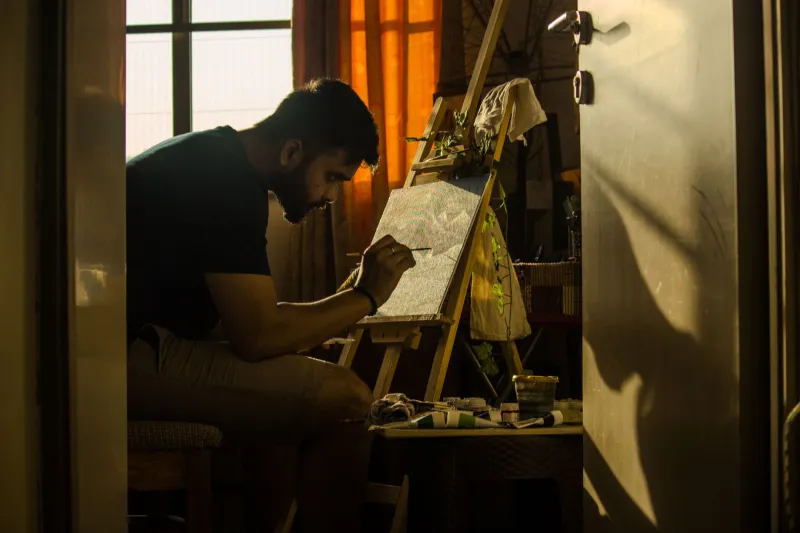
When you work alone, you stop performing for an audience — even the small internal audience of your collaborators or peers. You stop optimizing for approval mid-process. You start making decisions based purely on your own instincts, and those instincts get sharper the more you trust them.
Visual artists talk about this constantly, though rarely in the language of productivity or strategy. It's more intuitive than that. You need time with the work where no one else's energy is in the room. Where you're not explaining yourself, not defending choices, not compromising before you've even figured out what you actually believe.
That clarity — that hard-won sense of your own creative logic — is what you bring to a collaboration. Without it, you're not really collaborating. You're just deferring.
The Difference Between Collaboration and Dissolution
Here's where it gets uncomfortable: a lot of what gets called "collaboration" in the current creative economy is actually dissolution. It's the slow erosion of individual voice in favor of consensus, market fit, or the path of least resistance.
You see it in design studios where every decision gets committee-ed into blandness. You see it in music projects that sound like they were built by algorithm because, in a way, they were — assembled from whatever was working for other people at the time. You see it in young artists who've spent so much time in collaborative spaces that they genuinely don't know what they think anymore.
The artists who avoid that trap tend to have one thing in common: they figured out what they were doing alone before they let anyone else into the process. Not because they're precious about their vision, but because they have a vision. There's something to protect. There's something to bring.
When Phoebe Bridgers co-founded boygenius with Julien Baker and Lucy Dacus, all three of them arrived as fully developed solo artists with distinct, identifiable voices. The supergroup worked because no one had to dissolve into it. They could push against each other, complement each other, and still walk away as themselves.
The Cultural Pressure to Always Be Building Together
For South Asian creators in the US specifically, there's an added layer to this. The cultural expectation — from family, from community, sometimes from the broader industry that wants you to represent something — can be to always be building with, always be accountable to a collective identity.
And that impulse isn't wrong. Community has been a survival strategy. Collaboration has opened doors that individual hustle alone never could.
But it can also become a trap. When you're always making work for a community, or with a community, before you've made work just for yourself, you can lose track of the thread. The work becomes about belonging rather than expression. And belonging, while real and important, is not the same thing as art.
The most interesting South Asian creators working in the US right now are the ones who figured out how to hold both — who did the solitary work, built the internal foundation, and then brought that into community and collaboration. The sequence matters.
Solitude as a Creative Strategy, Not a Character Flaw
We need to stop treating the need for alone time as antisocial or as a luxury only established artists can afford. It's a legitimate creative strategy, and arguably one of the most important ones.
If you're an emerging artist feeling pressure to collab, to co-create, to always be building in public — it's worth asking what you're building toward. What do you actually want to say? What's the work that only you could make, in the way only you would make it?
Answer that first. Sit with it. Make something from it, even if it's rough, even if nobody sees it.
Then bring it to the table.
The best collaborations don't start with two people showing up empty-handed and hoping something appears. They start with two people who already made something — and who are curious enough about each other to see what happens when those somethings collide.
That's not a paradox, really. It's just the part of the story we keep leaving out.