Neither Here Nor There — And That's the Point: How In-Between Artists Are Inventing New Ground
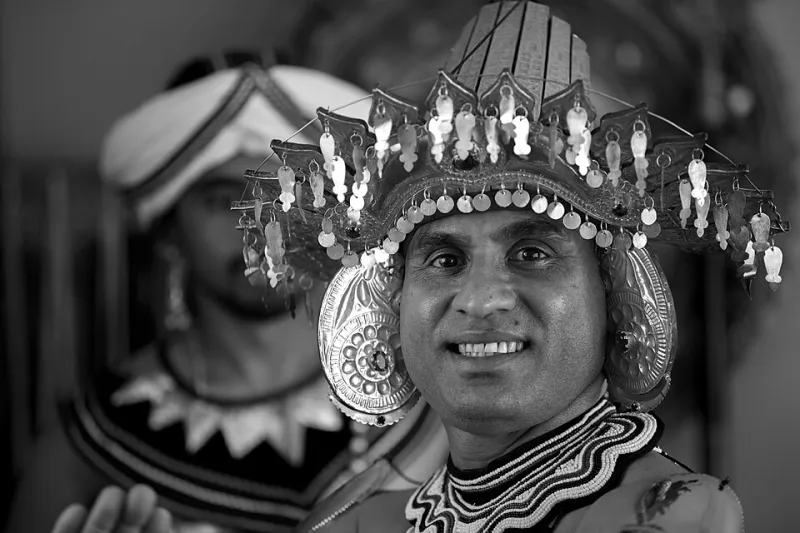
Photo: Department of Foreign Affairs and Trade, CC BY 4.0, via Wikimedia Commons
The Hyphen as Home
Grow up South Asian in America and someone will eventually ask you where you're really from. It's a question that assumes you belong somewhere fixed — that identity is a coordinate you can pin on a map. But for a lot of diaspora artists, the honest answer is more slippery than that. They're from the suburbs of New Jersey and from a city in Punjab they've only visited twice. They're from Bollywood soundtracks playing through apartment walls and from MTV, school cafeterias, and Saturday morning cartoons.
That double origin isn't a problem to solve. For a growing number of creatives, it's the whole point.
What's emerging from diaspora communities — South Asian, but also Caribbean, East African, Latinx, Southeast Asian — is a body of creative work that doesn't ask permission to belong. It doesn't fully claim one tradition or another. It sits in what cultural theorist Homi Bhabha famously called the "third space" — a zone where cultural meanings aren't inherited wholesale but negotiated, remixed, and sometimes just made up fresh.
What the Third Space Actually Looks Like
It's easier to feel than to define, but you know it when you encounter it.
It's the graphic designer whose visual language pulls from South Asian wedding aesthetics and 90s rave flyers in equal measure, and neither influence apologizes for the other. It's the musician who layers classical ragas over trap production without framing it as fusion — because fusion implies two separate things being combined, and this was never two separate things. It's the filmmaker who sets a story about intergenerational immigrant grief inside a genre horror framework, and the result is stranger and truer than either tradition would have produced alone.
The third space isn't a style. It's a disposition — a refusal to resolve the tension between cultural influences into something comfortable and categorical.
Visual artist and muralist Priya Nair, who splits her time between Los Angeles and her family's city of Chennai, describes it as "making work that would confuse everyone who has a claim on me, and somehow that's where I feel most free." Her large-scale public murals incorporate Dravidian temple architecture, West Coast graffiti lineage, and a color palette she describes as "neither traditional Indian nor anything you'd see in a design school — just mine."
Why This Moment?
Diaspora art isn't new. But the particular confidence with which younger creators are inhabiting the in-between feels different from even a decade ago.
Part of it is generational. Second and third-generation immigrants who came of age with the internet grew up with access to the full breadth of their cultural heritage and the full breadth of global creative production simultaneously. They didn't have to choose between listening to Carnatic music and listening to Kendrick Lamar. They didn't experience their parents' culture as something fragile and separate that needed to be protected from outside influence. It was all just... available, all at once, and they metabolized it accordingly.
Part of it is also a reaction against the pressure to perform a tidy cultural identity for mainstream consumption — which we've been talking about more honestly as an industry in recent years. When the market tells you to pick a lane, making deliberately lane-less work becomes an act of resistance.
And part of it is simply visibility. Diaspora artists are seeing each other's work more easily now, building informal communities across cities and platforms, and finding validation in the recognition that their specific in-between experience is shared and generative rather than isolated and disqualifying.
The Creative Advantage of Belonging Nowhere
There's a practical creative upside to existing outside any single tradition's jurisdiction: you're not bound by its rules of propriety.
Every established cultural tradition carries with it a set of expectations about what serious art looks like, what's sacred and what's available for play, what combinations are considered disrespectful or diluting. Artists who are fully inside a tradition navigate those expectations constantly. Artists who are genuinely outside — tourists, appropriators — navigate them badly, or not at all.
Diaspora artists occupy a third position. They have enough intimacy with multiple traditions to handle them with care and knowledge, but enough distance from any single one to combine and subvert freely. It's a particular kind of creative license that's hard to manufacture and impossible to fake.
New York-based textile artist Kiran Mehta, whose work weaves (literally) between South Asian handloom techniques and contemporary American quilt traditions, puts it this way: "I'm not trying to represent India or represent America. I'm representing the specific experience of being the person I am, which is both and neither. That's actually a very specific thing. It's not vague — it's precise."
Not Groundlessness — Groundedness in Motion
It's worth pushing back on one misreading of this creative position: the third space isn't rootlessness. It isn't cultural homelessness dressed up as aesthetic freedom.
The artists working here are deeply knowledgeable about the traditions they draw from. The irreverence is informed. The mixing is intentional. What they're rejecting isn't cultural grounding — it's the demand that grounding look a certain way, that it be singular and stable and legible to an outside audience.
There's something genuinely new being made in this space, and it doesn't have a clean name yet. It's not fusion. It's not multicultural. It's not hyphenated in the way that implies two things sitting uneasily side by side. It's something that could only exist right now, in this country, in this cultural moment — made by people who grew up holding multiple worlds in their hands and decided to build something with all of them at once.
Belonging nowhere, it turns out, can be its own kind of home.