What Did That Collab Actually Cost You? A Brutally Honest Audit for Creators
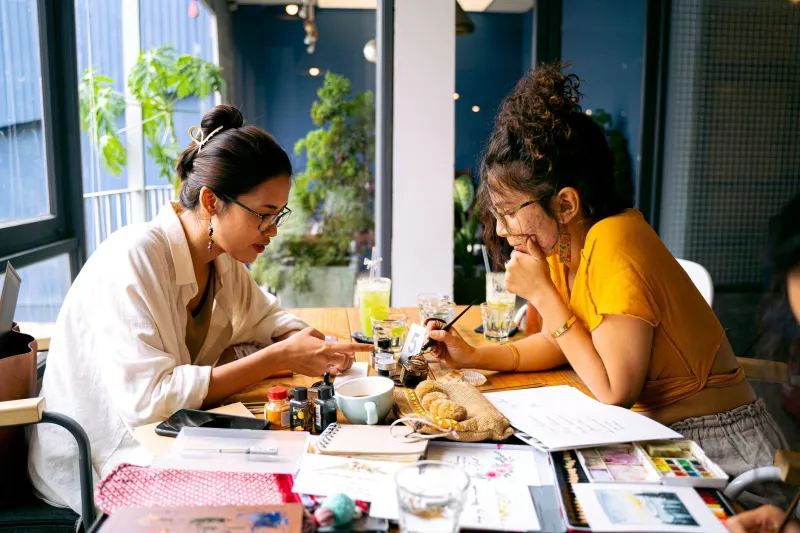
At some point, you agreed to something. Maybe it was a co-written project, a joint show, a shared social campaign, a feature, a brand collab, a creative partnership that felt exciting at the time and left you feeling vaguely depleted in ways you still haven't fully named.
Or maybe it was genuinely great, and you haven't stopped to appreciate how much it gave you because you were already onto the next thing.
Either way, most of us are walking around with a backlog of creative partnerships we've never properly accounted for. Not financially — though that too — but in the fuller sense. What did those collaborations actually do to your practice, your voice, your network, your sense of yourself as a creator?
This is the audit you probably haven't run. Here's how to do it.
Why Most Creators Skip This
The creative world doesn't really have a culture of retrospective evaluation. We're oriented toward the next project, the next opportunity, the next collaboration pitch landing in the inbox. Looking backward can feel like self-indulgence at best, bitterness-processing at worst.
But here's the thing: if you don't understand what your past collaborations actually gave and took, you'll keep making the same types of decisions — the ones that feel exciting in the moment and either pay off or don't in ways you can't predict or pattern-match.
The audit isn't about blame or regret. It's about data. Your data. The stuff only you have access to.
Building Your Collaboration Inventory
Start by listing every significant creative collaboration you've been part of in the last three to five years. Not just the formal ones with contracts — include the informal ones too. The friend group project. The Instagram series you co-ran. The EP you made with someone from your city. The writing partnership that faded out.
For each one, you're going to run it through four lenses.
Lens One: The Creative Ledger
This is about your actual work — not the work's reception, but what happened to your creative practice inside the collaboration.
Ask yourself: Did working with this person push you somewhere you wouldn't have gone alone? Did their process challenge yours in ways that grew you, or did it flatten you into a supporting role? Did you produce something that still feels like you, or does it feel like a compromise — or worse, like their vision with your name on it?
Also ask the inverse: Did you bring your full creative self to the table, or did you self-edit to keep the peace? If you self-edited, was that a reasonable negotiation or a pattern of erasure?
Creative collaborations that compound your practice feel generative even when they're hard. You come out of them with new tools, new reference points, new questions to explore. Ones that deplete you often feel smooth on the surface — low conflict, easy agreement — but you emerge from them smaller, somehow.
Lens Two: The Emotional Labor Accounting
This one's uncomfortable, but skip it at your own risk.
How much emotional work did you do to keep this collaboration functional? Did you manage someone else's ego, insecurity, or chaos while also trying to make the work? Was the labor evenly distributed — not just the creative tasks, but the relational maintenance, the scheduling, the conflict navigation, the cheerleading?
For a lot of creators — and this tends to fall along familiar lines of gender, seniority, and cultural background — the emotional labor in a collaboration is invisible and uncompensated. It doesn't show up in the credits. It doesn't get acknowledged in the press release. But it costs real energy that could have gone into the work.
If you're honest with yourself, you probably know which collaborations had you playing therapist, project manager, and peacekeeper on top of your actual creative role. That's worth naming, even if just to yourself.
Lens Three: Platform and Network Returns
Now let's talk about the stuff that's easier to measure.
Did the collaboration expand your audience? Did it introduce you to a community you couldn't have accessed alone? Did it lead to other opportunities — not immediately, but in the six to eighteen months following? Did the other person's network become part of your network in a real, reciprocal way, or did you get a one-time bump and nothing sticky?
Also worth asking: did the collaboration associate your name with something that helped or hurt your positioning? Some partnerships are worth less than their reach because of what they signal about you to the communities you actually care about.
This lens is about leverage. Did this collaboration give you more surface area, or did it mostly give the other person more surface area?
Lens Four: The Financial Reality Check
If money was involved, be honest about it. Was the split fair given the actual contribution? Did you negotiate from a clear sense of your own value, or did you accept less because you were excited or because you didn't want to seem difficult?
If money wasn't involved, ask whether it should have been. A lot of creative collaborations that are framed as "mutual benefit" or "exposure" are actually one party's unpaid labor funding another party's project. That framing is so normalized that it can be hard to see clearly — but the audit is the place to see it clearly.
What the Patterns Tell You
Once you've run a few past collaborations through these lenses, step back and look at the shape of it.
Are there types of collaborators who consistently show up in the depleting column? Are there structures — informal versus formal, short-term versus long-term, creative peers versus people at a different career stage — that tend to produce better outcomes for you?
Are you consistently over-contributing emotionally while under-contributing creatively, or vice versa? What does that tell you about where you default to in a partnership?
The goal isn't to decide you're done collaborating. Collaboration is one of the most powerful tools a creative has — and some of the most significant work in any field comes out of genuine creative partnerships. The goal is to get specific enough about what actually works for you that your next collaboration is a choice, not a reflex.
Before You Say Yes Next Time
Take the patterns you found and turn them into questions to ask before you commit. Not interrogation questions — just honest ones. What does each person expect to get from this? How will decisions get made when we disagree? What does success actually look like, and are we defining it the same way?
The collaborations worth having can answer those questions. The ones that can't are already telling you something.